Technology
Depth, color, and inference in one device
The platform is two halves that ship together: precision at the source, and intelligence at the edge. Hardware blocks measure the world in metric geometry; software blocks turn that measurement into a decision on the device.
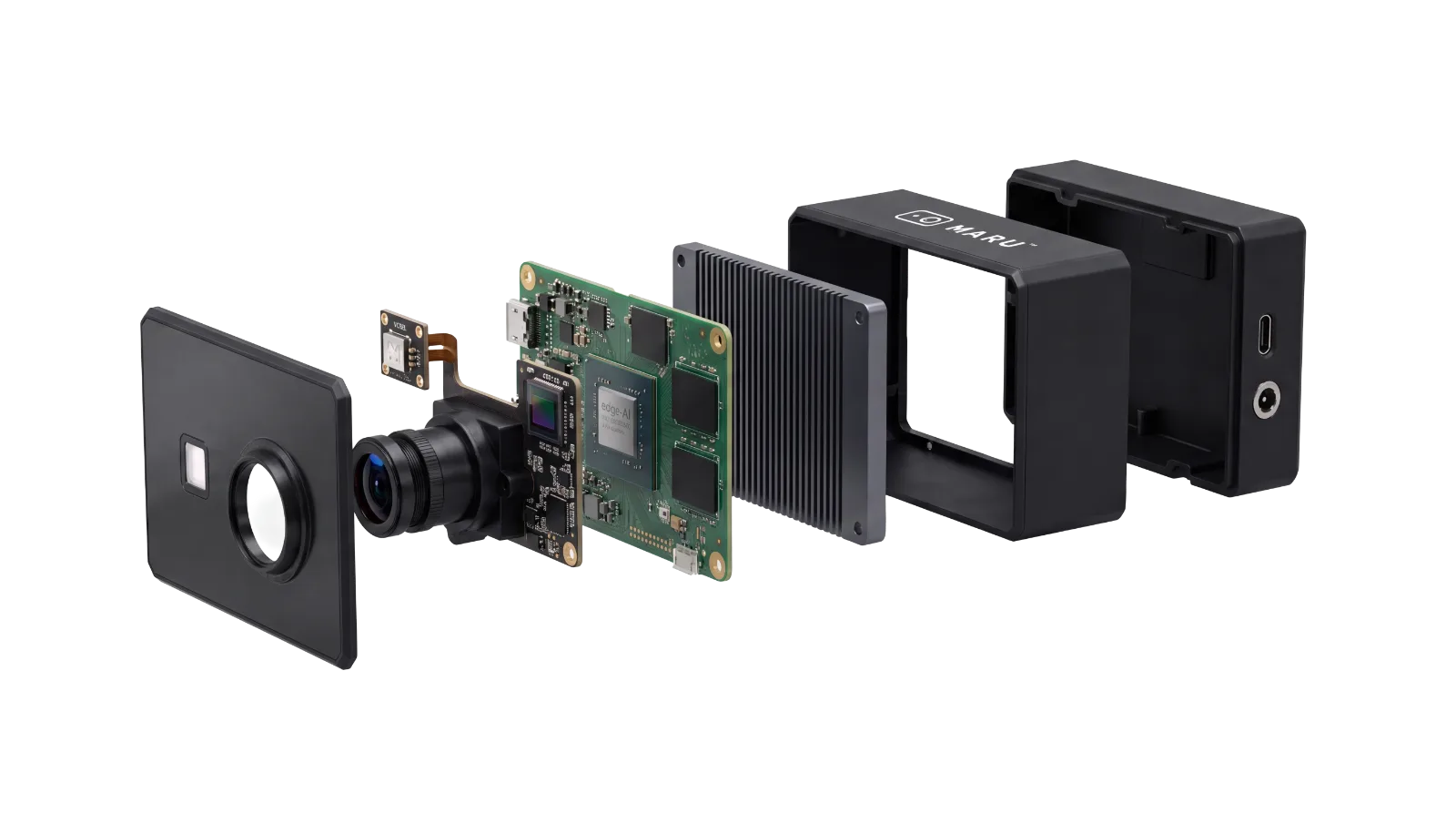
The stack

Two halves, built to ship together
Precision at the source and intelligence at the edge. The hardware blocks measure the world; the software blocks turn that measurement into a decision. Edge compute is where the two meet.
Precision blocks
Hardware — precision at the source
3D Camera Module
ToF 3D (VCSEL 940 nm) + RGB/IR fusion, with optics and package design in-house. Depth and color are taken on the same head, so a module leaves the line already sharing one coordinate frame and one clock. Distance comes for every pixel, from 0.2 to 20 m, within ±0.5%.
Hardware Interface
Host links: USB-C, Ethernet, SerDes, HDMI/DP. Standards: MIPI on the module side, GenICam and GigE Vision for machine-vision hosts.
Calibration & Production
Bring-up, alignment and calibration, thermal-drift compensation, in-field recalibration. Every unit ships with its own calibration record, and the lines that calibrate it are the lines that produce it at volume.
Intelligence blocks
Software — intelligence at the edge
3D Geometry / Vision AI
Reconstruction, spatial mapping, and coordinate transform turn the depth frame into geometry a machine can plan against. Above that: detection, segmentation, and 6-DoF pose estimation — what the object is, where its boundary lies, how it is oriented.
AI Vision SDK
Scene Perception, Point Cloud, and Depth APIs. Drop-in integration: the calls sit above the driver, so models and calibration can change underneath without touching application code.
Data Engine
A continuous learning loop — synthetic data, auto-labeling, then feedback from the field. Units already deployed keep contributing to the models they run.
Where the two meet
Edge Compute
On-device AI compute that runs across edge SoCs. The precision blocks deliver a calibrated frame, and the intelligence blocks consume it in the same device. That is what keeps a result inside a control cycle instead of a network round trip.
Precision blocks
Inside the perception head
Two measurements, one device — time-of-flight distance and calibrated color, taken on the same head.
Time of flight, 940 nm
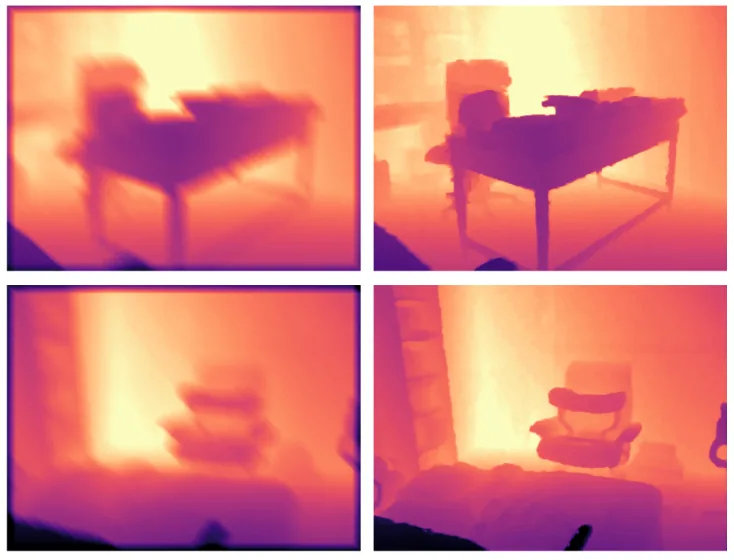
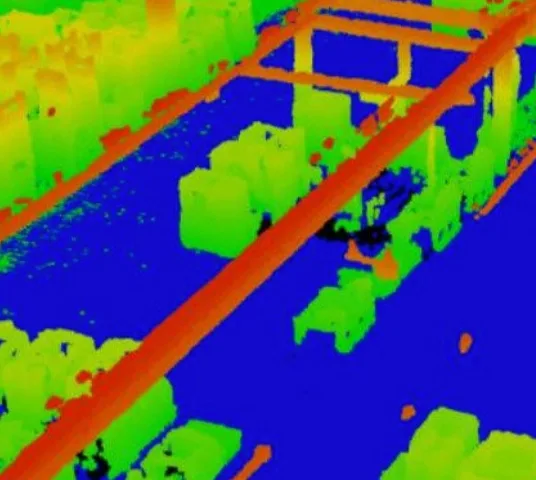
A VCSEL array emits at 940 nm and the sensor measures the return time per pixel. The result is a distance value for every pixel — 0.2 to 20 m, within ±0.5% — rather than a disparity estimate that degrades on untextured surfaces.
940 nm sits outside the visible band and away from the strongest part of the solar spectrum, which is what makes the same module usable indoors and outdoors. One and four-emitter variants trade illumination width against size.
Color and IR on the same head
RGB and IR from 5 MP to 8K, across a 45–155° diagonal field of view, sit on the same factory-calibrated head as the depth sensor. Because both are calibrated together, fusion is a property of the device instead of a task for the integrator.
That is the difference between buying two sensors and buying a perception head: one coordinate frame, one clock, one calibration record that ships with the unit.
Edge compute
The decision stays on the machine
Inference runs on the edge stage across edge SoCs, returning a result in 10–20 ms. A machine that has to wait for a server cannot close a control loop.
Above the driver the interface is ordinary: ROS 2 topics, or a REST/SDK API. Hardware links are USB-C, Ethernet, SerDes, and HDMI/DP depending on the body.
Specifications
Platform specifications
| 3D depth | ToF · VCSEL 940 nm · 0.2–20 m · ±0.5% |
|---|---|
| 2D imaging | RGB + IR · 5 MP–8K · 45–155° diagonal FoV |
| Frame rate | 30–60 FPS |
| Edge compute | Runs across edge SoCs · 10–100 TOPS · 10–20 ms on-device |
| Interfaces — HW | USB-C Ethernet SerDes HDMI/DP |
| Interfaces — SW | ROS 2 · REST/SDK API |
| Delivered as | Sensor + edge AI + I/O on one calibrated platform · Ruggedized field housing · factory-calibrated |
How we work together
From environment to production
Perception is specific to a place. The work starts by measuring the place, not by picking a part number.
Consulting
Environment profiling and a feasibility check: lighting, surfaces, distances, cycle time. We measure the environment before we propose anything.
Configuration — two ways forward
The profile decides which one. Most environments are met by the platform as it stands. Some need engineering alongside you.
MARU™ module supply
The profiled environment maps onto blocks that already exist. We fix the module mix — modality, range, field of view, interface — and tune it against your profile in simulation before any hardware ships. What you buy is a configured product.
See the MARU lineupCo-engineering
The profile falls outside what a configuration can reach. We design with you on the same stack — the same optics, calibration, edge compute, and SDK — so the result stays reusable instead of becoming a one-off. What you buy is engineering, delivered on our platform.
Development and mass production
Integration with the machine, QA and calibration on our own lines, then supply at volume. Both paths arrive here: 15+ years of camera-module mass production and in-house calibration.
Continuous updates
Deployed units keep improving as models and calibration are updated in the field.